

Iberian Lynx Conservation Awards presented in Cáceres, LIFE LYNXCONNECT
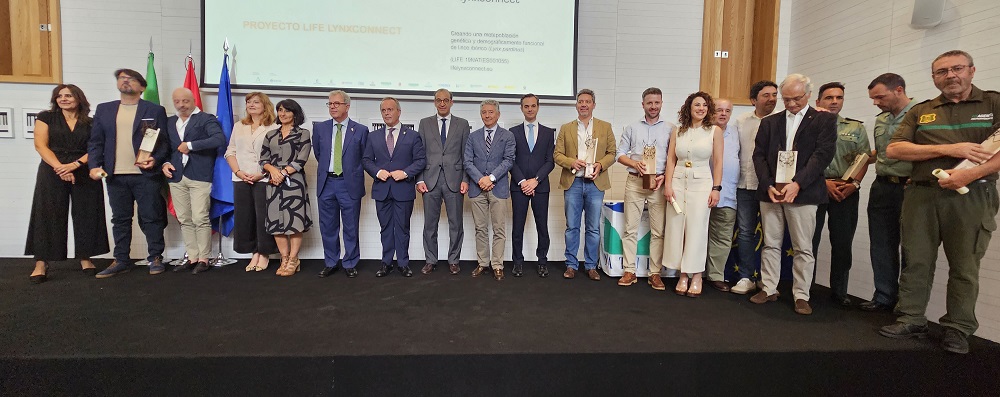
On Monday 9 June, the Iberian Lynx Conservation Awards were presented in Cáceres. These awards are given annually by the LIFE LYNXCONNECT Project, which will run for five years.
The recipients of these awards were nominated by the project partners and include individuals, groups, institutions and organisations that have made a significant contribution to the preservation and conservation of the Iberian lynx.
In Portugal, the Câmara Municipal de Mértola was recognised for its contribution to the conservation of this feline, as it was in Portuguese territory that its reintroduction began. The Câmara Municipal de Mértola quickly understood the added value and positive differentiation that this reintroduction represented for the population and economy of the municipality and has progressively and consistently supported the reintroduction and consolidation process with a reinforced commitment, facilitating and supporting the tasks inherent in monitoring and follow-up and being a key agent in raising awareness and providing clarification to local actors.
The Region of Murcia has awarded this prize to Don Juan Jiménez García, the owner of the first estate to sign up to this project in the Region of Murcia. Thanks to his willingness and trust, various measures have been carried out on his estate to strengthen the wild rabbit population, directly contributing to the improvement and viability of the Iberian lynx territory in the Highlands of Lorca.
Mr. Juan Jiménez is an example of how the involvement of the rural community and private landowners is essential to the success of conservation projects. His open, collaborative and proactive attitude has set a precedent that has inspired other landowners to join this cause.
The Regional Government of Andalusia has awarded the LIFE LYNXCONNECT prize to Mr Alfredo Sosa, who, together with his wife Ana María Sosa, who sadly passed away this year, are an example of collaboration and altruistic commitment to the conservation of the Iberian lynx. Since 2016, they have been collaborating in the conservation of this feline, laying the foundations for one of the main objectives of LIFE LYNXCONNECT: Improving the connection between population centres through small islands or ‘stepping stones’ where one or two territorial females could settle, and where the production of litters in these territories would shorten the connection between other more distant population centres.
In 2016, a lone female lynx appeared on Ana María and Alfredo’s estate and, partly thanks to their insistence, the possibility of releasing a male into the area a couple of years after the arrival of the female ‘Ignota’ was considered, instead of capturing the female and transferring her to one of the species’ population centres. The following spring, the first reproduction event took place, the first such event recorded in a ‘stepping stone’ area, thus consolidating the strategy to improve the connection between the different population centres.
Likewise, the Regional Government of Castilla-La Mancha recognises the Vigil de Quiñones Ferrer family, which owns the El Aprisco estate near Santa Cruz de Mudela in Ciudad Real in the area where the Iberian lynx is present in the Eastern Sierra Morena, where management and use compatible with biodiversity conservation is carried out, among other actions, thanks to sustainable agricultural practices, the application of alternative uses to hunting, the limitation of hunting of prey species of endangered species, and in general with the work, commitment and dedication of all the farm’s workers.
This approach has enabled the consolidation of land use with up to two stable Iberian lynx breeding territories since 2017 and has allowed more than 20 cubs born in the wild to be released into the natural environment. Today, together with Salmorejo and Ría, the four cubs from the previous year (Vera, Vigo, Volador and Vermut) remain in the territory.
Finally, among the award winners from Extremadura, the Association for the Development of the Campo Arañuelo Region (ARJABOR) was recognised for its collaboration, which has been fundamental in communicating and disseminating information about the increase in lynx populations in its area, and for its work in declaring the area a tourist product “Territorio lince” (Lynx Territory). The ARJABOR Association currently brings together and groups the interests of 20 municipalities in the north of Cáceres: Almaraz, Barquilla de Pinares, Belvís de Monroy, Berrocalejo, Bohonal de Ibor, Casas de Belvis, Casatejada, El Gordo, Majadas de Tiétar, Mesas de Ibor, Millanes, Navalmoral de la Mata, Peraleda de la Mata, Pueblonuevo de Miramontes, Rosalejo, Santa María de las Lomas, Talayuela, Tiétar, Valdecañas and Valdehúncar.
Similarly, Seprona has been recognised for the intense collaboration and surveillance work carried out by its agents in the lynx distribution centres in Extremadura. Beyond their duties and daily work, they have consistently demonstrated great professionalism and commendable enthusiasm in the exciting task of conserving the lynx in Extremadura. Special thanks go to the field patrols.
In this edition, an honorary award has been given to João Alves for his involvement in the conservation of the Iberian lynx and his support and fundamental role in the reintroduction of the species in Portugal.
João Alves is a biologist who graduated from the Faculty of Sciences of the University of Lisbon in 1982. He has been a senior technician at the ICNF since November 1982, with experience in botany, vegetation sciences and natural habitats, having participated in the drafting of the Habitats Directive between 1989 and 1992.
He held various management positions between June 1999 and June 2013, including Vice-President of the ICN between December 2004 and May 2007, Director of several Natural Parks and Member of the Boards of Directors of the public companies Polis Litoral Ria Formosa and Polis Litoral Sudoeste.
In July 2013, he became involved in the conservation of the Iberian lynx, coordinating the ex situ component (CNRLI) of the Action Plan for the Conservation of the Iberian Lynx in Portugal (PACLIP-2008). Since mid-2014, he has participated in the in situ component of PACLIP (reintroduction into the natural habitat of the Guadiana Valley), which is part of the LIFE Iberlince project; since September 2020, in the LIFE Lynxconnect project; and since October 2021, in the LIFE Iberconejo project.
He has been responsible for coordinating the ex situ and in situ components of PACLIP and has participated, on behalf of Portugal, in the Iberian Lynx Working Group, where his contribution to the development of the Strategy for the Conservation of the Iberian Lynx in Spain and Portugal has been considered very important. He was recently elected to the National Board of Directors of the Order of Biologists of Portugal.
Congratulations to all of them. Their support and collaboration have been one of the cornerstones on which all the achievements have been built, such as the revision of the threat category, the increase in population and the recovery of historical areas.